How to Successfully Migrate Large-Scale Data Ingestion Systems
A step-by-step guide to migrating large-scale data ingestion systems, covering lifecycle framework, validation, rollout controls, and gradual cutover. Based on Meta's experience with petabyte-scale social graph data.
Introduction
Migrating a data ingestion system at the scale of Meta—where petabytes of social graph data are processed daily—is a monumental task. The shift from a legacy system with customer-owned pipelines to a self-managed data warehouse service required careful planning, robust controls, and a step-by-step approach. This guide outlines the key strategies and steps used to achieve a seamless migration, ensuring data integrity, reliability, and performance at hyperscale. Whether you’re moving a small pipeline or an enterprise-wide ingestion system, these principles can help you navigate the complexity.

What You Need
- Clear migration objectives: Define success criteria such as data quality, latency, and resource usage.
- Old and new system access: Both systems must be operational in parallel for comparison and rollback.
- Job inventory: A complete list of all ingestion jobs, their dependencies, and owners.
- Automation tools: Scripts or orchestration platforms to manage migration lifecycle (e.g., Kubernetes, Airflow, custom tooling).
- Monitoring and alerting: Systems to track data quality, latency, and resource utilization.
- Rollback plan: Predefined steps to revert any job to the legacy system if issues arise.
- Cross-team coordination: Stakeholders from engineering, data science, and operations to validate results.
Step-by-Step Guide
Step 1: Establish a Migration Lifecycle Framework
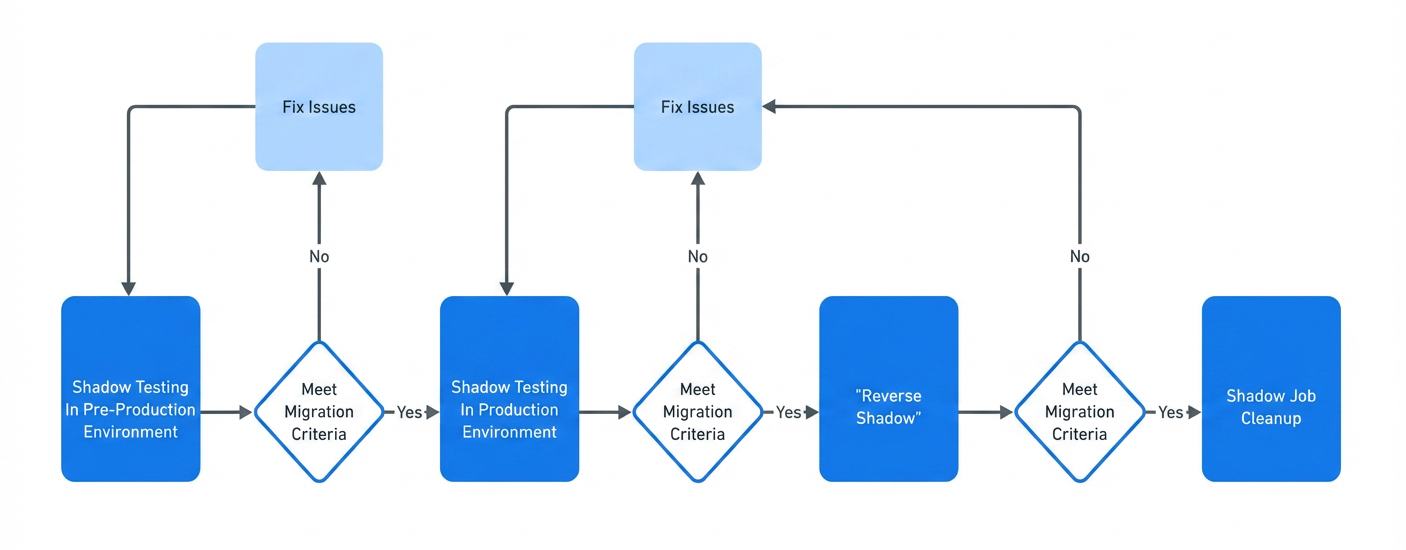
Before migrating any job, define a clear progression path. Each job must pass verification gates before advancing to the next stage. Create stages such as Validation, Canary, Gradual Rollout, and Full Cutover. For example, Meta used a lifecycle where jobs were first tested in a sandbox, then moved to a low-risk subset, then gradually increased traffic. Document the criteria for each stage.
Step 2: Inventory and Prioritize All Ingestion Jobs
List every data ingestion job currently running on the legacy system. Group them by criticality, data volume, and downstream impact. High-priority jobs (e.g., those feeding real-time dashboards or ML models) deserve extra scrutiny. For each job, note its source (e.g., MySQL shards), transformation logic, destination (data warehouse tables), and SLAs. This inventory becomes your migration roadmap.
Step 3: Build Parallel Validation Infrastructure
Set up the new system to run alongside the legacy system for the same data sources. Create a validation pipeline that compares outputs from both systems. Key comparisons include:
- Row count: Ensure the number of rows written is identical.
- Checksums: Compute a hash (e.g., MD5) over the data to detect any differences in values.
- Timestamp checks: Verify that new system delivers data within the same or better latency window.
- Resource usage: Compare CPU, memory, and network utilization to detect regressions.
Step 4: Implement Rollout and Rollback Controls
Design a safe mechanism to migrate jobs incrementally. For each job, create a toggle that can switch between the old and new system at the configuration level. Use feature flags or a migration controller that can route traffic to either system. Ensure that rollback can happen within minutes. For Meta, this meant each job had a migration state that could be instantly reverted if any verification failed.
Step 5: Execute a Canary Migration
Start with a small, low-impact job (e.g., a table with few users or low update frequency). Run it through the full lifecycle: validation, canary (e.g., route 1% of traffic to new system), then gradual increase to 100%. Monitor all verification metrics continuously. Only proceed to the next job after the canary passes all criteria for at least 48 hours (or your business cycle). Document any issues and refine the process.
Step 6: Automate Verification and Alerting
Develop automated scripts that run after each ingestion cycle to compare old vs. new data. Set up dashboards showing:
- Data quality score (0–100%)
- Latency deviation (milliseconds)
- Resource trend charts
- Number of failed checks
Step 7: Gradually Migrate All Jobs in Batches
Group jobs by criticality and data source. Migrate non-critical jobs first to build confidence. Then move to medium-priority, and finally high-priority. For each batch, follow the same lifecycle: canary → gradual rollout → full cutover. Keep the legacy system operational for all jobs until the entire batch is verified. Meta migrated thousands of jobs over several months, ensuring each batch had a two-week stabilization period before moving to the next.
Step 8: Monitor, Iterate, and Deprecate Legacy System
Once all jobs are on the new system, continue monitoring for at least one full business cycle (e.g., one month). Verify that no latent data quality issues emerge. Then, begin deprecating the legacy system—shut down redundant pipelines, decommission servers, and remove code. Document lessons learned and update your migration framework for future system changes.
Tips for Success
- Invest in automation early: Manual verification doesn’t scale. Build comparison tools before you start migrating.
- Communicate clearly: Keep all stakeholders informed of migration progress and potential impacts. Use status dashboards accessible to everyone.
- Plan for worst-case scenarios: Design rollback to be as fast as rollout. Practice rollback drills with dummy traffic.
- Expect edge cases: Some jobs may have unique transformations or dependencies. Handle them individually rather than forcing a one-size-fits-all approach.
- Measure everything: Track migration velocity, error rates, and team fatigue. Use data to adjust timelines.
- celebrate milestones: Large migrations can be demoralizing. Recognize progress to maintain team morale.
Migrating a data ingestion system at scale is like changing the engine of an airplane mid-flight. With a structured lifecycle, robust validation, and incremental rollouts, it is possible to achieve a seamless transition. The key is to prioritize data integrity and operational reliability at every step.