7 Key V8 Optimizations Behind a 2.5x Speedup in JetStream2
V8 optimized mutable heap numbers to eliminate allocations in Math.random, yielding 2.5x speedup in JetStream2 async-fs. Key steps include ScriptContext tagging, immutable HeapNumber cost, and mutable in-place updates.
In the relentless pursuit of faster JavaScript execution, the V8 team continuously analyzes benchmark suites to identify performance bottlenecks. A deep dive into JetStream2 uncovered a surprising culprit: the Math.random function. By optimizing how numeric values are stored and updated, V8 achieved a remarkable 2.5x improvement in the async-fs benchmark. This article breaks down the seven critical steps and concepts behind this optimization, revealing how seemingly minor implementation details can create major performance cliffs—and how clever engineering can smooth them out.
1. The Quest for Performance Cliffs
V8's engineering team treats benchmark suites like JetStream2 as diagnostic tools. These suites simulate real-world workloads, and any sudden slowdown—a performance cliff—signals an opportunity for improvement. By profiling each benchmark with fine-grained tools, the team can pinpoint where the engine stumbles. In the case of JetStream2, the async-fs benchmark (which mimics file system operations) showed unexpected latency. The root cause wasn't I/O but a seemingly unrelated function: Math.random. This discovery underscores that even well-trodden code paths can hide inefficiencies when the JIT compiler and garbage collector interact in unforeseen ways.
2. JetStream2 and the async-fs Benchmark
The async-fs benchmark is a JavaScript implementation of an asynchronous file system. It creates, reads, and writes virtual files using callbacks and promises, putting heavy stress on V8's asynchronous execution model. Despite being synthetic, it mirrors patterns found in Node.js applications that rely on fs operations. Crucially, to ensure deterministic results across runs, the benchmark substitutes the default Math.random with a custom pseudo-random number generator (PRNG). This PRNG maintains a seed variable that is updated on every call. While the PRNG itself is efficient, V8's internal handling of that seed variable introduced a surprising bottleneck.
3. The Hidden Math.random Bottleneck
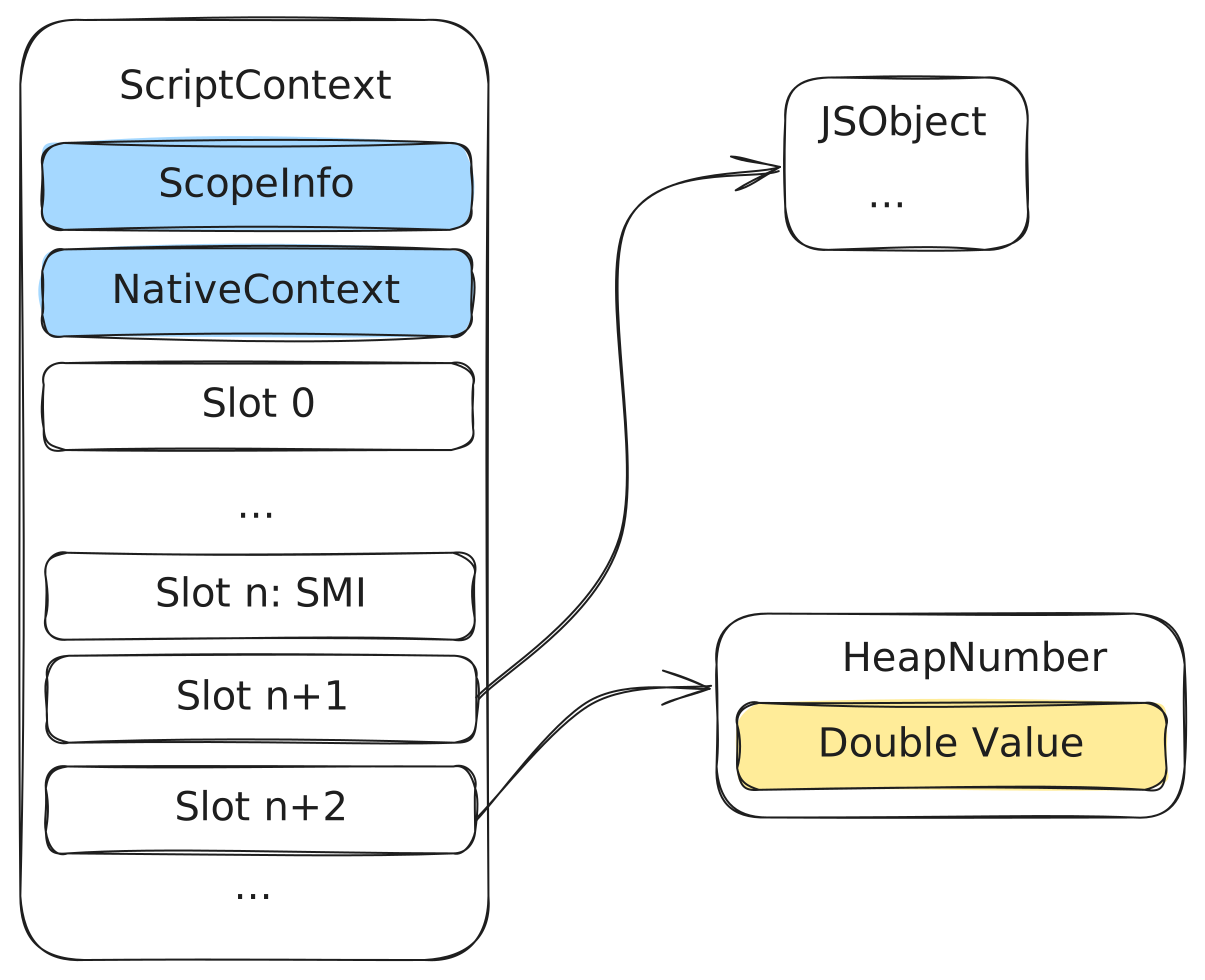
Inside the custom PRNG, the seed variable undergoes a series of bitwise operations, each updating its value. Profiling revealed that each update triggered a new heap allocation. The seed, being a 64-bit floating-point number, could not be stored as a small integer (SMI) because its value exceeded the 31-bit range and involved decimal parts. Instead, V8 placed it in a ScriptContext as a tagged pointer to a heap-allocated HeapNumber. Every assignment to seed created a fresh HeapNumber object, leading to thousands of unnecessary allocations per second—and consequently, increased garbage collection pressure.
4. How V8 Stores Numbers: ScriptContext and Tagging
To understand the bottleneck, we must examine V8's internal representation of variables. A ScriptContext is an array of tagged values, each occupying 32 bits on 64-bit systems. The least significant bit distinguishes Small Integers (SMI) (tag bit = 0) from pointers to heap objects (tag bit = 1). SMIs hold 31-bit integer values directly (shifted left). Larger numbers or those with fractions must be stored as HeapNumber objects—immutable 64-bit doubles on the heap. The ScriptContext then stores a compressed pointer to that HeapNumber. While efficient for the common SMI case, this design forces an allocation every time a non-SMI variable changes, because the HeapNumber cannot be updated in place.
5. The Cost of Immutable HeapNumbers
Immutability of HeapNumbers simplifies many aspects of V8's optimizer and garbage collector, but it comes at a price. In the async-fs benchmark, the seed variable changes on every call to Math.random—potentially thousands of times per benchmark iteration. Each change requires allocating a new HeapNumber, writing the new floating-point value, and updating the pointer in the ScriptContext. Over the duration of the benchmark, this constant allocation floods the garbage collector with short-lived objects. The collector spends cycles reclaiming these HeapNumbers, causing pauses that add up to the observed performance cliff. Moreover, the allocation itself consumes CPU time that could be used for actual computation.
6. The Optimization: Introducing Mutable Heap Numbers
V8's solution was to allow certain HeapNumbers to become mutable. When the engine detects that a HeapNumber is used exclusively as a local variable inside a hot function (like the PRNG), it can mark that HeapNumber as mutable. Instead of allocating a new object, V8 then modifies the existing HeapNumber's value in place. This eliminates the allocation and reduces garbage collection pressure. The key insight is that no other references to that HeapNumber exist, so mutation is safe. In the async-fs benchmark, this change yielded a 2.5x speedup for the entire benchmark and contributed significantly to the overall JetStream2 score improvement.
7. Impact and Real-World Relevance
While the optimization was inspired by a benchmark, it reflects patterns common in real-world code. Many applications use custom PRNGs, accumulate large numbers, or perform repeated assignments to floating-point variables. The mutable heap number optimization benefits any code that frequently updates non-SMI numeric variables in hot loops. V8's approach also demonstrates the value of profiling: a 2.5x gain in one benchmark might translate into modest but measurable improvements in actual applications, especially those heavy on mathematical computations or stateful number manipulation. As V8 continues to evolve, such targeted optimizations help close the gap between JavaScript and traditionally compiled languages.
Conclusion
V8's success with mutable heap numbers shows that performance optimization often lies in rethinking fundamental assumptions. By allowing safe mutation of number objects under controlled conditions, the engine eliminated a major performance cliff without compromising the safety guarantees of the JavaScript language. The result is a faster, more predictable runtime for both benchmarks and real-world applications. As developers, understanding these internal mechanisms can help us write code that plays well with modern JIT compilers—and appreciate the engineering that makes our software fly.